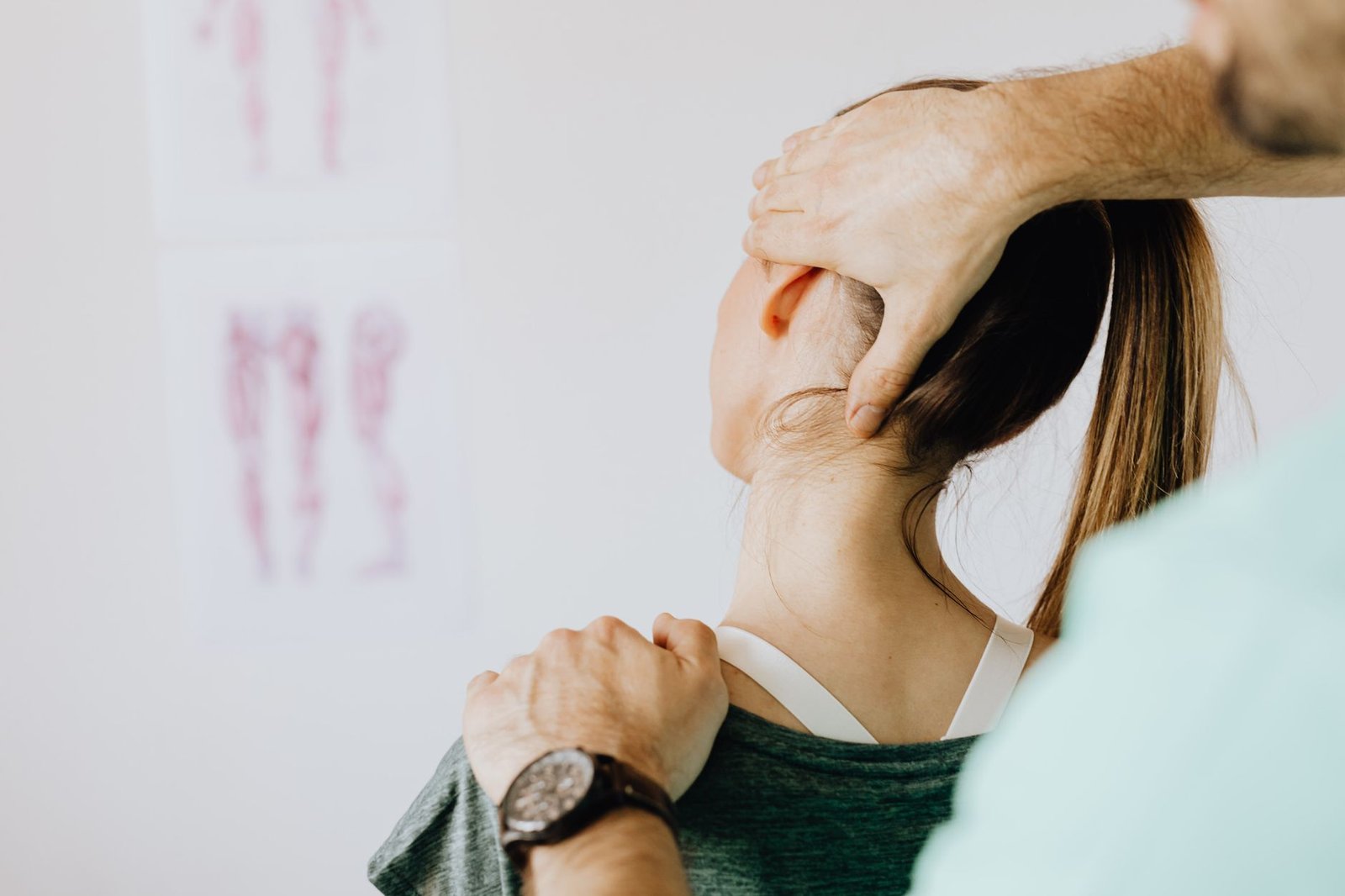
PINCHED NERVE IN THE NECK
It is what everybody calls it and it is not quite what happens. The distinction matters, because it explains why rest does not fix it and why most people get better anyway.
What is actually going on
The medical term is cervical radiculopathy. A nerve root leaving the spine is irritated — sometimes mechanically compressed by a disc fragment or by bone narrowing the exit foramen, and frequently inflamed by chemical mediators released from a torn disc without much compression at all.
That second mechanism is the one the phrase misses, and it explains a great deal: why the pain is often out of proportion to what the scan shows, why anti-inflammatory treatment works when purely mechanical logic says it should not, and why the pain settles over months as the inflammation resolves without anything physically moving.
What it feels like
- Pain that travels from the neck into the shoulder blade, down the arm, and often into specific fingers.
- Pins and needles or numbness in a strip rather than the whole hand — the strip is the diagnostic information.
- Weakness in particular movements — lifting the arm, straightening the elbow, gripping.
- Worse with the neck extended and turned toward the painful side; better with the hand on top of the head, which is a genuinely characteristic sign.
The single most reassuring fact
The natural history is good. The large majority of cervical radiculopathy improves without surgery, and improvement continues over months rather than weeks. That is not optimism — it is what the natural-history literature shows, and it is the reason patience is an active treatment strategy here rather than a failure to act.
It is also the reason we do not send people for a surgical opinion at the first appointment. Operating on something that was going to resolve is a real harm, and it is common enough to be worth naming.
When patience is the wrong answer
Progressive weakness is different from painful weakness. So is any sign that the spinal cord rather than the root is involved — clumsy hands, buttons and coins becoming difficult, a change in walking, or bladder disturbance. Those are on the urgent list and they do not wait.
Everything else has time, and using that time to establish the diagnosis properly is a better investment than using it to wait for a scan appointment.
What we do about it
Confirm the level from the distribution and the examination. Use nerve studies where the picture is ambiguous or where an entrapment at the wrist or the elbow is competing for the diagnosis. Treat the inflammation, which is frequently the dominant mechanism. And where the pain is severe or not settling, a targeted epidural steroid injection delivered to the level that matches the examination.
We evaluate and refine the diagnosis before anybody is routed onward. That is a standing policy on this site and it exists because the alternative — a referral made on a scan report and a symptom description — is how people end up operated on for the wrong level.
Why the scan is not the answer by itself
Disc bulges, foraminal narrowing and degenerative change are extremely common in people with no symptoms at all, and their frequency rises steadily with age. A scan finding earns the diagnosis when it matches the examination and the distribution. On its own it is a description of a neck that has been used, which is what most necks are.
How the level is worked out
Each root has a signature. C5 gives shoulder pain and weak abduction. C6 gives thumb and index finger symptoms with a weak biceps and a reduced brachioradialis reflex. C7 gives middle-finger symptoms with a weak triceps. C8 gives little and ring finger symptoms with weak grip and small hand muscles.
Those patterns overlap between people and are not perfectly reliable, which is why they are combined with provocation testing and, where it matters, with electrodiagnosis rather than treated as definitive on their own.
The competing diagnoses worth naming
- Carpal tunnel syndrome, which is far more common than most C6 radiculopathy and produces thumb-side symptoms.
- Cubital tunnel syndrome, which produces the C8 distribution from the elbow.
- Shoulder pathology, which produces upper arm pain that stops above the elbow.
- Thoracic outlet syndrome, in a smaller number of genuine cases.
- More than one of the above at once, which is the answer more often than a single tidy diagnosis.
What happens at the appointment
The distribution gets mapped, the strength and reflexes get graded and written down, and the provocation tests get done. If the picture is clean and there are no red flags, treatment starts that day. If it is ambiguous, the test that resolves the ambiguity gets ordered — and nothing irreversible is set in motion on an unresolved diagnosis.
What we treat it with, in order
Anti-inflammatory treatment, because chemical irritation is frequently the dominant mechanism rather than pure compression. Movement, kept up deliberately, because stiff necks recover worse. Load management rather than rest. And where the pain is severe or is not following the expected curve, a targeted injection at the level the examination points to.
That last one is where precision earns its money. An injection delivered to the level named on a scan report rather than the level named by the examination is a common and avoidable waste, and it is the reason we confirm the level ourselves.
Sleep, which nobody asks about
Arm pain that is worse at night is normal in radiculopathy and is one of the harder parts to live with. A pillow that supports the neck in neutral rather than pushing the head forward, and the affected arm supported on a pillow rather than hanging, changes the night for a lot of people.
It is worth arranging properly rather than enduring, because sleep loss raises pain sensitivity and adds a second problem on top of the nerve.
What people ask about a pinched nerve
How long will it take?
Most people improve substantially over six to twelve weeks, and some take longer. Steady improvement in a slow timeframe is the normal course, not a sign that something is being missed. How long neck pain should take to settle.
Should I rest it?
No. Relative activity modification, yes; immobility, no. Necks stiffen quickly and stiffness adds a second problem on top of the first. What EMG and nerve conduction actually measure. Protective disuse is the most common self-inflicted complication here — along with four others worth avoiding.
Do I need an MRI right away?
Only if there are red flags or if the result would change what happens next. Early imaging in the absence of either mostly finds age-related change and adds worry. What a herniated disc does and does not explain.
Why does putting my hand on my head help?
It reduces tension on the nerve root by shortening its path. It is called the shoulder abduction sign and it is one of the more specific findings for a root problem. The epidural steroid injection explained.
Could it be something other than my neck?
Yes — carpal tunnel, ulnar compression at the elbow, a shoulder problem, or two of those together. Which is why the distribution and the examination matter more than the label. What a compressed root actually causes.
Related reading
- Cervical radiculopathy
- Cervical epidural steroid injection
- EMG and nerve conduction studies
- Carpal tunnel, or the neck?
- When a neck problem is urgent
- Why your MRI does not explain it
Before the label settles, it is worth knowing what else gets called a pinched nerve — four conditions produce the same complaint and none of them are treated the same way.
Get the level confirmed before anyone operates on it
Most pinched nerves settle. The ones that do not deserve a diagnosis made on an examination, not a scan report.
12174 Natural Bridge Rd, Suite 302
St. Louis, MO 63044
Next to DePaul Hospital, just off the 270 and 70 junction, west of the airport.
Sources
- Panther EJ et al. Thoracic outlet syndrome: a review. J Shoulder Elbow Surg, 2022. PubMed 35963513