CERVICAL EPIDURAL STEROID INJECTION
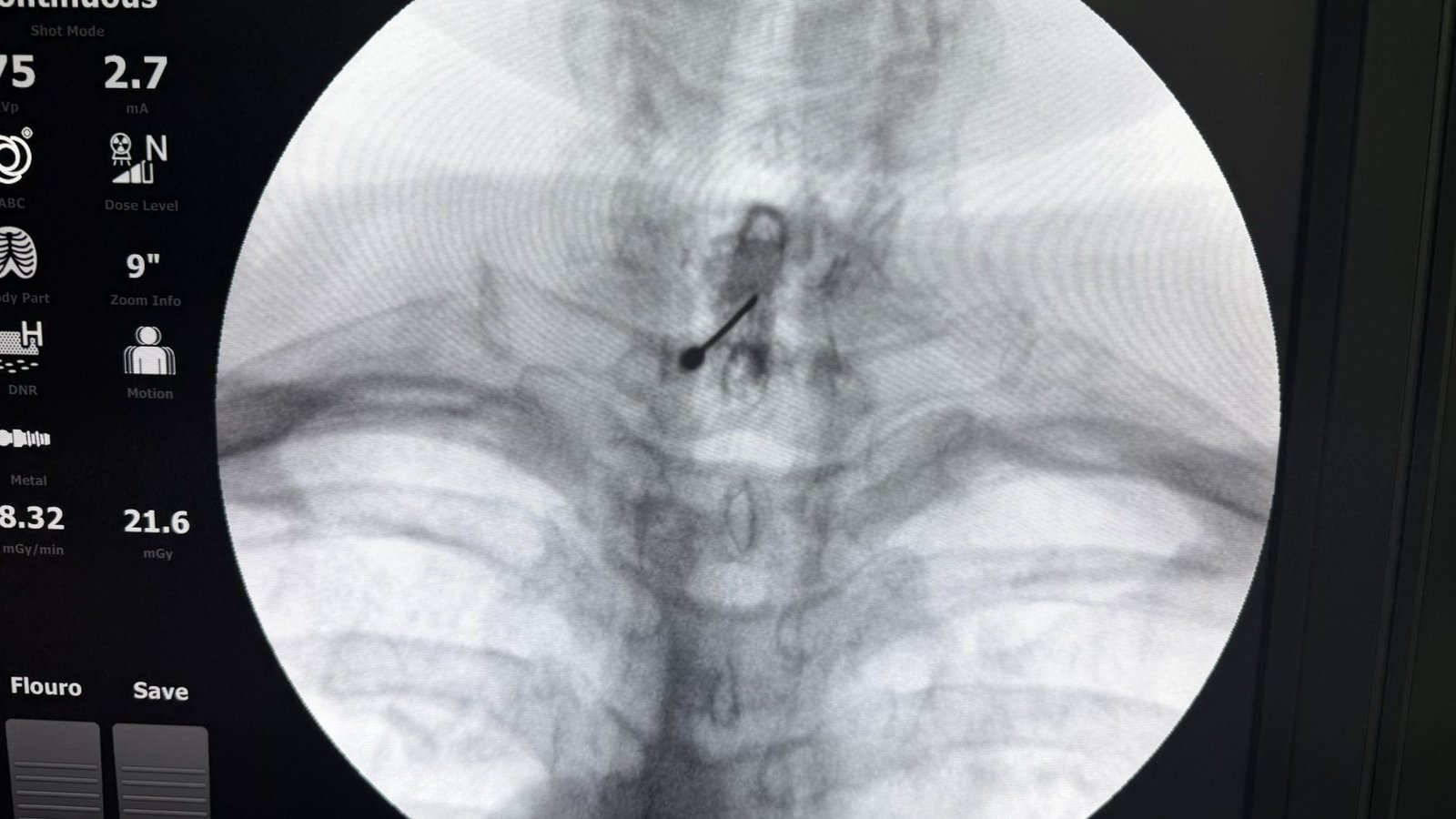
A cervical epidural steroid injection delivers anti-inflammatory medication to the specific nerve root that is inflamed. It does not go to your whole body, where it mostly misses the nerve. The injection treats arm pain from an irritated root. The level is chosen from the exam. The shot is done under live fluoroscopy (real-time X-ray).
What does a cervical epidural steroid injection treat?
A nerve root can be chemically irritated and mechanically compressed. That produces arm pain. Much of what makes it hurt is inflammation, not the compression itself. Oral anti-inflammatory treatment reaches that site poorly. An epidural injection puts a high concentration of medicine right where the problem is.
The target is a specific level. It is chosen from the exam and checked against imaging — not the level a report named. Getting the level right is most of what decides whether this works.
What is the difference between an interlaminar and a transforaminal injection?
Interlaminar delivers medication into the epidural space from the midline. It usually goes in at a level below the target and relies on spread. Transforaminal delivers it directly along the sleeve around the nerve root. That is more targeted, and it tells us more about the diagnosis.
They are not interchangeable, and they do not carry the same risk. Cervical transforaminal injections have a known risk tied to the arteries in the foramen (the opening where the nerve exits). Several things exist to address that risk. They are the technique, the needle position, contrast checks under live fluoroscopy and the choice of what is injected. Anybody offering this should be able to explain which approach they use and why.
How is a cervical epidural steroid injection done?
- Under fluoroscopy, always. This is not a procedure done by feel from surface landmarks.
- Contrast dye goes in first and is watched in real time. It confirms the spread and rules out uptake into a blood vessel.
- Small volumes. More medication does not mean more effect. It means less precision about where the effect came from.
- Awake and talking. That way any warning sign is reported as it happens, not found afterward.
What to expect afterward
Local anesthetic gives a few hours of relief that is diagnostic, not therapeutic — it tells us the level was right. The steroid effect builds over several days to two weeks. A day or two of extra soreness at the injection site before improvement is common.
We ask for a simple hourly record over the first six hours and then daily for two weeks. That record is what the next decision rests on, and an impression recorded a week later is not a substitute for it.
What it does and does not do
It treats the inflammation. It does not remove a disc fragment, widen a foramen or reverse degenerative (breaking-down) change. This condition’s natural history (its usual course) is largely favorable. So that is frequently enough — it controls the pain while the problem resolves on its own.
Some people have a progressive neurological deficit (nerve function that keeps getting worse). For them, this is not the treatment, and delaying with it would be the wrong call. For somebody with severe pain and an intact exam, it is often exactly the right one.
How many cervical epidural injections can you have?
It is not a series to be completed. It is done when it is indicated. It is repeated if the first one gave a good response that faded and the problem is still resolving. It is stopped when it is not working. Repeating an injection that produced nothing is not a plan.
Say two well-placed injections at a confirmed level have done nothing. Then we ask three things. Is the level right? Is the mechanism inflammatory at all? Or is something other than the root making the pain?
Who should not get a cervical epidural steroid injection?
Anybody with an active infection, an uncontrolled bleeding risk, or an allergy to the contrast or the medication. Anybody on anticoagulation (blood thinners) that has not been discussed and managed in advance. And anybody without an established diagnosis. That is because an injection is not a diagnostic shortcut around an exam.
Poorly controlled diabetes is a relative issue, not an absolute one. The steroid raises blood glucose predictably for several days. We plan for it instead of discovering it.
Where this sits in the sequence
After the diagnosis. After a fair trial of the things that do not involve a needle, unless the pain is severe enough that waiting is not humane. Before any talk of surgery in somebody whose exam is intact. That is because the natural history of radiculopathy (a pinched nerve root) is good. It is also because operating on something that was going to settle is a permanent answer to a temporary problem.
The exception, again, is progressive neurological loss. It does not wait for a trial of anything.
What a good response looks like
Arm pain substantially reduced within two weeks, better sleep, and the ability to start moving and loading normally. Numbness frequently lags behind pain and can take months to recover. That is expected and is not a sign of failure.
What we are looking for is a window in which the problem resolves. The injection buys that window. The recovery happens inside it.
What we tell people to record
Hourly for six hours, then daily for two weeks. Use a simple zero-to-ten score for the arm pain and a separate one for the neck pain. That is because they frequently behave differently, and that difference tells us something.
The first six hours are the local anesthetic. They answer whether the level was right. The following two weeks are the steroid. They answer whether the treatment is working. Blending the two into one impression loses both answers.
Why we do not do a fixed series
The idea of three injections spaced weeks apart is a scheduling convention, not a clinical one. Each injection should be a decision based on what the previous one did. If the first produced a complete and lasting response, a second may never be needed. If it produced nothing, repeating it is not a treatment plan.
We do one well-placed injection at a confirmed level and then reassess. We prefer that to signing up for a course before we know if it works.
Frequently asked questions about cervical epidurals
Is it dangerous?
The cervical spine deserves respect. This procedure has a real technique behind it — fluoroscopic guidance, live contrast, small volumes. Done properly it is safe. The safeguards exist because they matter. How a root problem is confirmed.
Will I be asleep?
No. Being awake and able to report symptoms is part of how the procedure is kept safe. What a pinched nerve in the neck means. Staying awake is a diagnostic decision and a safety one.
How long does relief last?
Anywhere from weeks to permanently. It depends on whether the underlying problem is resolving. In radiculopathy, which usually settles, a lasting result is common. Cervical disc herniation.
Does the steroid have side effects?
A few days of flushing, poor sleep or raised blood sugar are the usual ones. We discuss diabetes beforehand because the blood sugar effect is real and predictable. How a root problem is confirmed.
What if it does not work at all?
That is information. It usually means the level is wrong or the mechanism is not inflammatory. Both change what we do next. What a herniated disc does and does not explain.
How long does it take for a cervical epidural steroid injection to work?
The numbing medicine works within hours, and that early relief mostly tells us the needle reached the right level. The steroid itself builds over several days to two weeks. A day or two of extra soreness where the needle went in is common before the arm pain eases. Numbness often recovers more slowly than pain, sometimes over months, and that is expected rather than a sign the injection failed.
Does a cervical epidural steroid injection fix a herniated disc?
No. It treats the inflammation around the irritated nerve root. It does not remove a disc fragment, widen the opening the nerve passes through, or reverse wear in the spine. In a condition that usually settles on its own, that is often enough: the injection controls the pain while the problem resolves. The injection buys the window, and the recovery happens inside it.
Should you try a cervical epidural before neck surgery?
For most people with arm pain and an intact nerve exam, yes. Radiculopathy usually settles. Operating on something that was going to settle is a permanent answer to a temporary problem. We try the options that need no needle first, unless the pain is too severe for waiting to be humane. The exception is nerve function that is steadily getting worse. That does not wait for a trial of anything.
How painful is a cervical epidural steroid injection?
A few seconds of sting while the skin is numbed, then a dull, deep pressure as the needle reaches the epidural space. Some people feel their usual arm symptom flicker for a moment; say so when it happens, because that report is part of how the injection is kept safe. You stay awake, with no sedation. Every neck procedure, described by what you actually feel.
How long should I rest after a cervical epidural steroid injection?
Two to four hours, not two to four days. Most people return to normal activity, work included, the same day and drive themselves home. The exception is an arm that feels heavy or numb from the local anesthetic: get a ride, and wait for it to wear off before you use that arm for anything that matters. Resting the neck for days afterward buys nothing, because a neck held still stiffens and recovers slower. Which movements to restart, and which to leave for later.
Related reading
- Cervical radiculopathy
- Pinched nerve in the neck
- Cervical disc herniation
- EMG and nerve conduction studies
- When a neck problem is urgent
- Why your MRI does not explain it
Most radiculopathy settles before an injection is needed, which makes the first six weeks worth spending well. The things that slow it down.
Have the level confirmed before it is injected
An injection delivered to the level your examination names is a treatment. One delivered to the level a report names is a guess.
12174 Natural Bridge Rd, Suite 302
St. Louis, MO 63044
Next to DePaul Hospital, just off the 270 and 70 junction, west of the airport.
Sources
- House et al. Cervical Epidural Steroid Injection: Techniques and Evidence. Phys Med Rehabil Clin N Am, 2018. PubMed 29173656
- Hasoon et al. Risks and Benefits of Cervical Transforaminal Epidural Steroid Injections: A Comprehensive Review. Curr Pain Headache Rep, 2025. PubMed 40172800
- Epstein et al. Major risks and complications of cervical epidural steroid injections: An updated review. Surg Neurol Int, 2018. PubMed 29740507
- Kleimeyer et al. Cervical epidural steroid injections: incidence and determinants of subsequent surgery. Spine J, 2020. PubMed 32565316