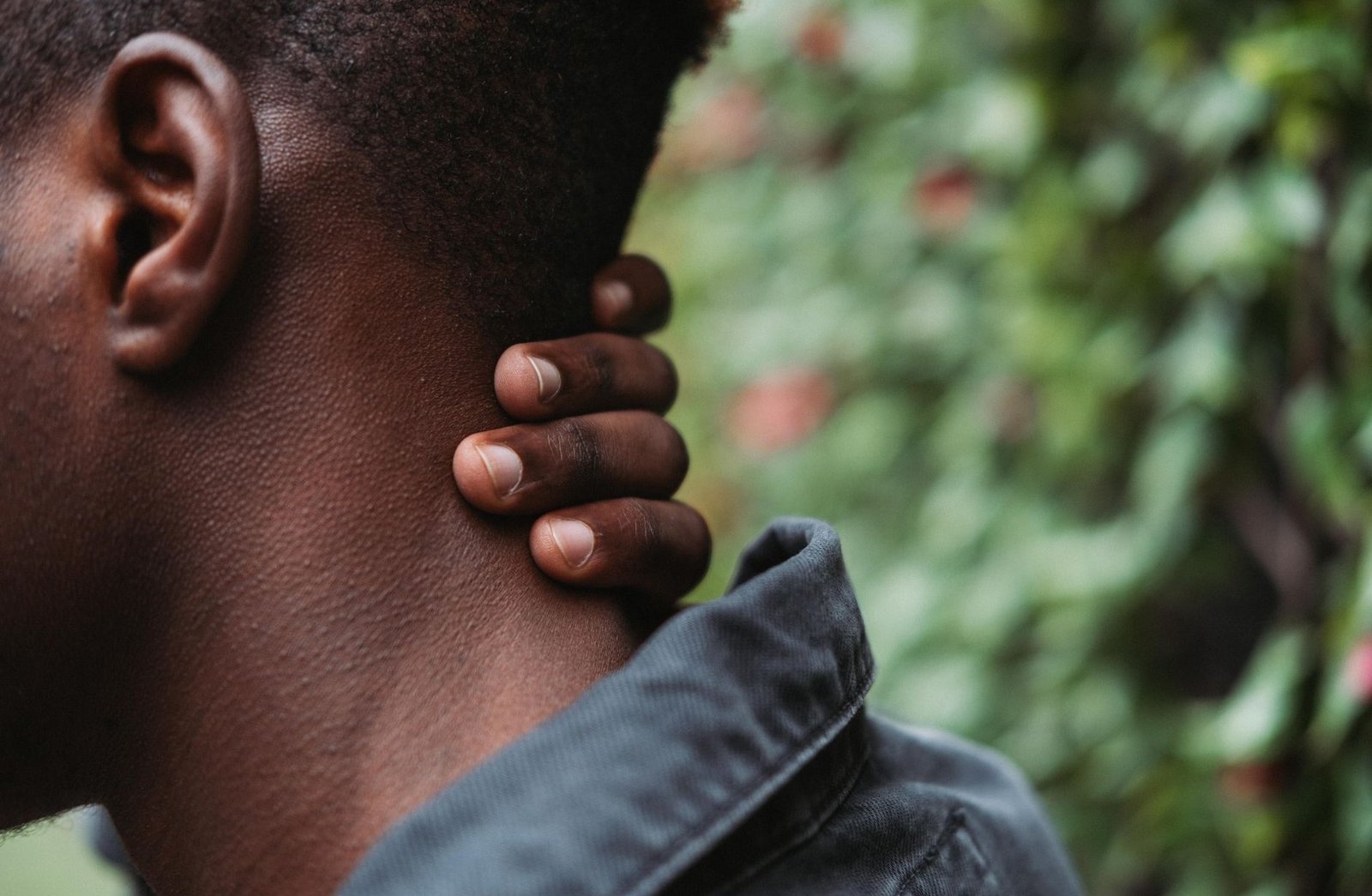
LEFT OR RIGHT
More than the intensity does. Sidedness is one of the few things you can report that narrows the structure before anyone has touched you — and one of the few that changes what a procedure would even look like.
One side usually means one joint
The facet joints are paired, two at every level, one on each side. A joint on the right cannot refer pain to the left. So a pain that stays on one side, does not cross the midline, worsens on extension and rotation toward that side, and refers into the shoulder blade or the base of the skull in a consistent map is behaving exactly the way a facet joint behaves.
That is not a small observation. Facet-mediated pain accounts for a substantial share of persistent neck pain, it is invisible on imaging, and its referral maps are segment-specific enough to be useful. Sidedness is the first filter and costs nothing to establish.
Both sides is a different question
Symmetry changes the differential rather than doubling it. Pain across the whole back of the neck is usually muscular and load-related. But symptoms in both arms — numbness, clumsiness, a change in handwriting or in how you walk — are not two pinched nerves that happened at once. Bilateral upper-limb symptoms point toward the central canal and the cord rather than toward a nerve root, and that is a different clock. The short list that does not wait includes this one.
Side plus fingers gives you the level
Side narrows to a column. Fingers narrow to a row. Together they specify a single nerve root, which is the unit everything downstream is actually delivered to. Right-sided neck pain with numbness in the right thumb and index finger is a right C6 story until something contradicts it — and the finger map is worth learning before your appointment.
Where sidedness misleads
Three ways, and all three are common enough to plan around.
- Muscle referral does not respect your expectations. A trigger point in the sternocleidomastoid refers to the same-side ear, jaw and behind the eye, and patients reasonably describe that as a head problem rather than a neck one. One muscle produces a remarkable amount of it, and referral patterns generally travel further than people expect.
- The side may be telling you about your job, not your spine. Which arm reaches for the mouse, which shoulder carries the bag, which way the second monitor sits. A neck that is worse on Thursday and fine by Sunday is reporting a loading pattern, and the side is the clue that identifies it.
- Shoulder pathology is emphatically one-sided too. Unilateral pain is not self-evidently cervical. The shoulder gets scanned, injected and treated in a large number of people whose problem sits six inches away.
Why we ask before we plan anything
Because the diagnostic procedures are sided. A medial branch block anesthetizes the two small nerves supplying one facet joint on one side; there is no such thing as blocking “the neck.” If that block abolishes the pain and a confirmatory block repeats the result, the joint has been identified and ablation becomes a reasonable conversation. If the pain was never one-sided to begin with, the whole sequence was aimed at the wrong target.
Bilateral facet pain does exist and gets treated bilaterally. The point is that it has to be established rather than assumed, because assuming it doubles a procedure for someone who needed half of one.
What this is worth to you
You can supply this yourself, for free, before any appointment: which side, whether it crosses the midline, which fingers if any, and what movement reproduces it. Four answers. In our experience they narrow the field further than the first scan usually does, and they are the difference between an examination that starts from your neck and one that starts from a report about it.
Four answers, then an examination
Which side, whether it crosses the midline, which fingers, and what movement brings it on. Bring those and the first visit starts well ahead of where it usually does.
12174 Natural Bridge Rd, Suite 302
St. Louis, MO 63044
Next to DePaul Hospital, just off the 270 and 70 junction, west of the airport.
Sources
- Hurley RW et al. Consensus practice guidelines on interventions for cervical spine (facet) joint pain from a multispecialty international working group. Regional anesthesia and pain medicine, 2022. PubMed 34764220
- Blanpied PR et al. Neck Pain: Revision 2017. The Journal of orthopaedic and sports physical therapy, 2017. PubMed 28666405
- Kang KC et al. Cervical Radiculopathy Focus on Characteristics and Differential Diagnosis. Asian spine journal, 2020. PubMed 33373515
- Tetreault L et al. Degenerative Cervical Myelopathy: A Practical Approach to Diagnosis. Global spine journal, 2022. PubMed 35043715
- Iyer S et al. Cervical radiculopathy. Current reviews in musculoskeletal medicine, 2016. PubMed 27250042