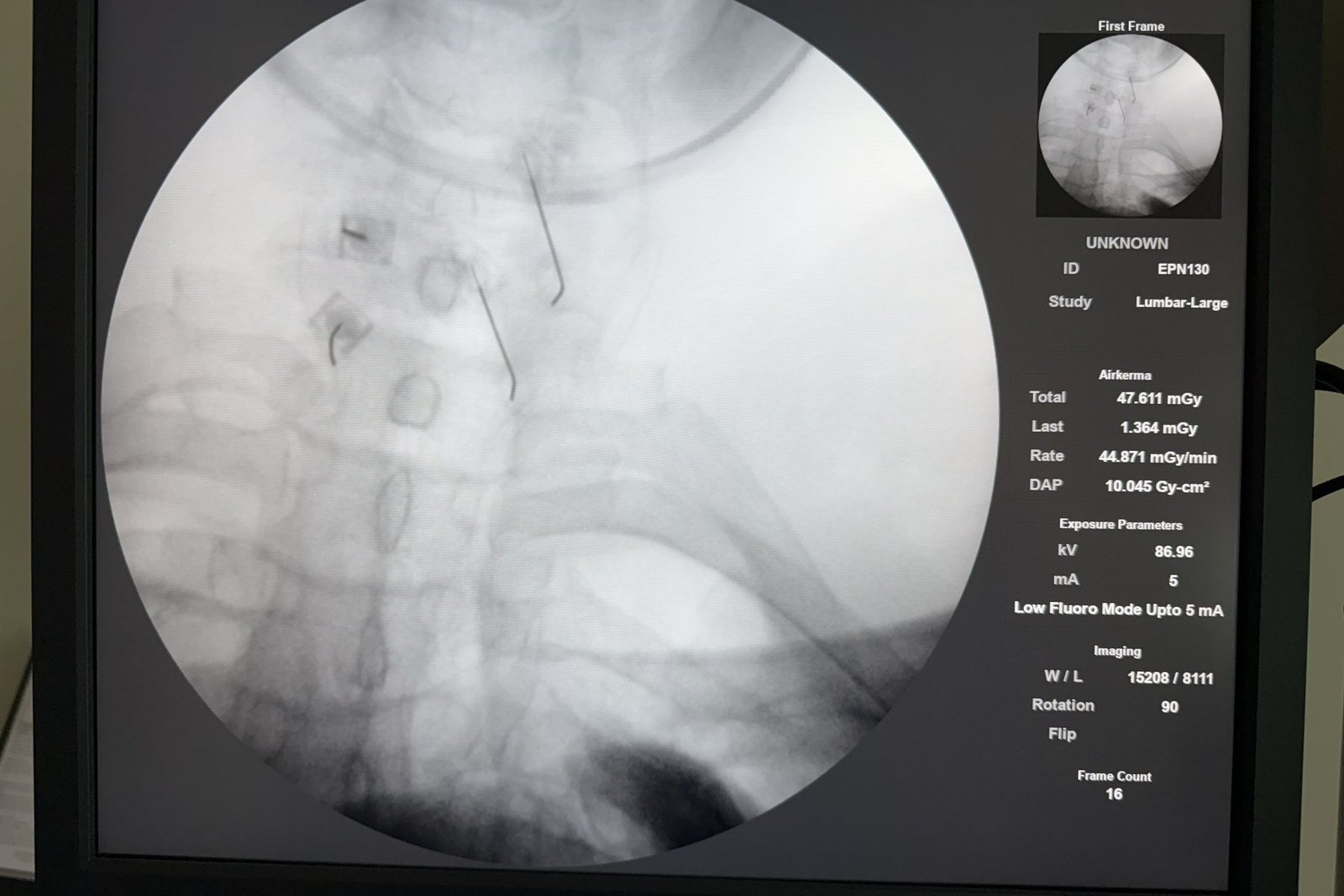
CERVICAL RADIOFREQUENCY NEUROTOMY
Cervical radiofrequency ablation (neurotomy) heats the small medial branch nerves that report pain from the neck’s facet joints. So the joint stops sending the signal. Relief lasts until the nerves regrow, typically six to eighteen months. This is the one interventional treatment for neck pain with a truly lasting answer — and it only works if the right nerves were found first. That is where most of these fail.
How does cervical radiofrequency ablation work?
Each cervical facet joint is supplied by two medial branch nerves. These are small sensory nerves whose only job is to report from that joint. Radiofrequency neurotomy heats a short segment of those nerves to interrupt them, so the joint stops reporting pain.
It is not a treatment for the joint. The arthritis, if there is any, is unchanged. What changes is that the joint can no longer send the signal. That is why the benefit lasts as long as the nerve takes to regrow — typically somewhere between six and eighteen months, sometimes considerably longer.
Why do you need a medial branch block before radiofrequency ablation?
The medial branches are the target only if the facet joints are the source. Nothing on an MRI establishes that. What establishes it is a diagnostic medial branch block — numbing the specific nerves and seeing whether the pain goes.
A single block gives false positives often enough to matter. That is why the guidelines favor confirming before ablating. Treating on a single equivocal (unclear) block is how a procedure with good evidence gets a reputation for not working.
What the evidence supports
Consensus practice guidelines from the multisociety working group on cervical facet joint interventions back radiofrequency neurotomy. But they back it in appropriately selected patients. That phrase carries the weight. Selection means confirmed blocks, not a scan finding.
More recent guidance has been more cautious about interventional spine procedures in general. It is worth saying so, rather than quoting only the supportive documents. What the cautious readings share is a criticism of selection, not of the technique. Done on confirmed facet pain, it performs. Done on unconfirmed axial neck pain (pain in the neck itself), it does not. Both findings sit in the same literature.
What happens during a cervical radiofrequency ablation?
- Prone or seated, depending on the levels. Local anesthetic at the skin.
- The needle is placed under fluoroscopic guidance (live X-ray). It goes onto the articular pillar (the bony column of the joint) at each target level. This is not a landmark procedure (done by feel). It is not done without imaging.
- Sensory and motor stimulation testing comes before any heat is applied. It confirms the electrode is on the target nerve and not near a motor root.
- Lesioning for 60 to 90 seconds per site. Several sites per level, because the nerve is not a point.
- Home the same day. No sedation is used; you stay awake under local anesthetic, and most patients drive themselves home.
How long does it take to recover from cervical radiofrequency ablation?
The first week is frequently worse. Neuritic soreness (sore, irritated nerves) and a deep ache in the treated area are expected, not a complication. People who were not warned about it conclude the procedure failed. Benefit typically shows itself between two and four weeks as that settles.
When the nerves regenerate, the pain returns, and the procedure can be repeated. That is the honest shape of it. This is durable relief, not a cure, and anybody describing it as permanent is overselling.
Who is not a candidate for cervical radiofrequency ablation?
- Anyone whose blocks were negative or equivocal — the target has not been confirmed.
- Radicular arm pain. That is a nerve root problem and a different diagnosis.
- Progressive neurological deficit or cord signs. These need a surgical opinion.
- Segmental instability (too much motion between two spine bones). No ablation addresses it.
When the pain comes back, which it will
The nerves regenerate. That is not a complication; it is the mechanism. The honest framing is that this buys a set period of relief, not a cure. Most people come back somewhere between six and eighteen months.
Repeat procedures generally work about as well as the first. That is the useful thing to know. What changes the answer is whether anything else has changed — a new radicular (nerve root) symptom, a new level, a worsening gait. That matters because a repeat should never be booked without asking if the first diagnosis still holds.
If it does not work at all
Three questions, in order. Were the blocks truly positive, or was one equivocal and treated as positive because everyone wanted to proceed? Were the correct levels targeted, given that referral patterns overlap? And is there a second pain generator — a disc, a root, a shoulder — that was always going to limit the result?
Repeating an identical procedure that did not work, without changing any of those inputs, is not a plan. It is the most common thing that happens next. It is why people arrive here having had three.
Conventional and cooled radiofrequency
Conventional radiofrequency makes a small lesion (heat spot) around the active tip. Cooled radiofrequency runs fluid through the electrode. So a larger area can be heated without charring. That gives a bigger target zone where the anatomy is uncertain.
For cervical medial branches, the target is small and the anatomy is well mapped. So we use conventional technique here, with careful placement and stimulation testing. Larger is not automatically better next to a motor root (a nerve root that moves muscle).
What people ask about cervical ablation
How long does cervical radiofrequency ablation last?
Typically six to eighteen months, occasionally longer. It depends on how quickly the medial branch nerves regenerate. It is repeatable when the pain returns. What a diagnostic block proves.
What is the success rate?
In properly selected patients — meaning confirmed diagnostic blocks — the majority get meaningful relief. In unselected patients the numbers fall sharply. That is the biggest single cause of the spread in results you will read about. Ablation or fusion?
How painful is the procedure?
Uncomfortable rather than severe, with local anesthetic at each site. The week afterward is usually the harder part, and it is temporary. How facet pain is confirmed. Test stimulation first, then the lesion, and an ache for a few days afterward.
Will it weaken my neck?
The medial branches carry sensation from the joint. They also supply the small multifidus muscles at that segment. Some multifidus atrophy (muscle shrinking) occurs. It has not been shown to cause meaningful functional weakness. It is a real trade-off, not a nothing. The block that settles it.
What is the downside of radiofrequency ablation?
It is not a cure. The nerves regrow, so the pain usually returns within six to eighteen months, although the procedure can be repeated. The first week is often sorer than before. The small multifidus muscles at the treated level lose some bulk. That has not been shown to cause meaningful weakness. And it only works if diagnostic blocks confirmed the facet joints first.
Why am I in so much pain after radiofrequency ablation?
The first week is frequently worse than before the procedure. Soreness from the treated nerves and a deep ache in the area are expected, not a complication, and they settle. Benefit typically shows up between two and four weeks. If there is no benefit at all after that, the questions are these. Were the blocks truly positive? Were the right levels treated? Or does a second pain source exist?
Can cervical radiofrequency ablation be repeated?
Yes. When the medial branch nerves regenerate and the pain returns, the procedure can be repeated. Repeat procedures generally work about as well as the first. Before booking one, the original diagnosis should be checked again. A new arm symptom, a new level or a change in walking means something else may have changed and needs a fresh look first.
What can be done instead of cervical radiofrequency ablation?
That depends on why ablation is off the table. If the facet joint is confirmed but you would rather not have its nerves treated, PRP placed inside the joint is the option for trying repair first; in a 2026 trial in neck facet pain it equaled steroid on pain and disability at six months. Steroid inside the joint works for a shorter time. If the blocks were negative, the alternative is a different diagnosis, not a different facet treatment. Deep neck muscle loading runs alongside every one of these. The orthobiologic options for the neck.
Related reading
- Diagnostic medial branch block
- Cervical facet syndrome
- Ablation compared with fusion
- Cervicogenic headache
- What happens at the first visit
- Neck pain doctor in St. Louis
Get the blocks done before the ablation
If the facets have not been confirmed as the source, the ablation is a guess. Confirming it is a short appointment with an immediate answer.
12174 Natural Bridge Rd, Suite 302
St. Louis, MO 63044
Next to DePaul Hospital, just off the 270 and 70 junction, west of the airport.
Sources
- Hurley RW et al. Consensus practice guidelines on interventions for cervical spine (facet) joint pain from a multispecialty international working group. Reg Anesth Pain Med, 2022. PubMed 34764220
- Busse JW et al. Commonly used interventional procedures for non-cancer chronic spine pain: a clinical practice guideline. BMJ, 2025. PubMed 39971339
- Sherwood D et al. Cervical medial branch block progression to radiofrequency neurotomy: A retrospective clinical audit. N Am Spine Soc J, 2021. PubMed 35141655
- Manchikanti L et al. Comprehensive Evidence-Based Guidelines for Facet Joint Interventions in the Management of Chronic Spinal Pain: American Society of Interventional Pain Physicians (ASIPP) Guidelines Facet Joint Interventions 2020 Guidelines. Pain Physician, 2020. PubMed 32503359